Boiler Repair Bath: When Is a Combi Boiler Fault Still Worth Repairing?
Find out when a faulty combi boiler is worth repairing, which warning signs matter and when replacement may be the more practical option.

Why you can trust our content
We understand that the boiler industry can be confusing, with plenty of outdated or misleading information. That’s why we rely only on trusted, proven sources to guide our advice and installations:
At a glance
A faulty boiler does not always mean you need a new one. Some problems come from relatively straightforward component failures, while others point to wider wear, recurring faults or an appliance that is approaching the end of its useful life. Knowing the difference can help you decide what to do next without spending money unnecessarily.
For homeowners considering boiler repair Bath services, the most useful starting point is to establish what has gone wrong, how serious the fault is and whether the appliance can be restored reliably.
The age of the boiler matters, but it is not the only factor. Repair costs, the availability of replacement parts, the condition of the wider heating system and the likelihood of further breakdowns should all influence your decision.
This guide explains the signs to look out for, when a repair may be sensible and when it is worth discussing a replacement with a qualified heating professional.
What Are the Signs That a Combi Boiler Needs Attention?
Boiler problems can develop gradually or appear without warning. Some faults affect comfort, while others may indicate that the appliance needs urgent professional attention.
Common warning signs include:
- Radiators staying cold when the heating is switched on.
- Hot water becoming inconsistent or taking longer to arrive.
- The boiler repeatedly switching off or displaying a fault code.
- Unusual banging, humming or kettling noises.
- Water leaking from the boiler or nearby pipework.
- Repeated pressure loss that requires frequent topping up.
- Heating controls failing to communicate properly with the appliance.
These symptoms do not all point to the same cause. For example, cold radiators may be linked to trapped air, a circulation problem or a faulty component. A pressure drop could indicate a leak, an expansion vessel problem or another issue that needs investigation.
It is better to have the cause identified than to assume that the boiler itself has failed.
If the boiler is showing signs of a fault,
When Is Repairing a Combi Boiler Usually Worthwhile?
Repairing a boiler is often worth considering when the fault is clearly identified, the necessary parts are available and the cost is reasonable in relation to the appliance’s condition.
A relatively modern boiler that has been maintained properly may still have many useful years ahead of it. Replacing a faulty sensor, valve or other serviceable component could restore normal operation without the expense of installing a new appliance.
A repair may be a sensible option when:
- The boiler has generally operated reliably.
- The fault is limited to a replaceable component.
- Suitable parts are available.
- The repair cost is proportionate to the boiler’s age and condition.
- There are no significant safety concerns or signs of widespread deterioration.
- The appliance continues to meet the household’s heating and hot water needs.
However, a seemingly small fault can sometimes reveal a more serious underlying problem. A professional diagnosis is therefore important before deciding whether to repair or replace the appliance.
The decision should be based on the likely outcome of the work, not simply the cheapest immediate option.
Which Boiler Faults Can Often Be Repaired?
Many combi boiler problems can be addressed without replacing the entire appliance. The repair required depends on the symptoms, the boiler model and the condition of its components.
| Symptom | Possible cause | Appropriate next step |
|---|---|---|
| No heating | Thermostat fault, circulation issue or boiler component failure | Check the controls and arrange professional diagnosis. |
| Hot water fluctuates | Sensor, heat exchanger or flow-related problem | Have the hot water function assessed. |
| Boiler loses pressure | Leak, expansion vessel fault or pressure-related issue | Arrange checks to identify the cause of the pressure loss. |
| Repeated shutdowns | Faulty sensor, circulation problem or another internal fault | Record any fault code and contact an engineer. |
| Banging or kettling | Restricted circulation, limescale or overheating | Arrange an inspection rather than ignoring the noise. |
| Water leaking nearby | Loose connection, seal failure or internal component problem | Have the source identified and assessed promptly. |
This table is a guide, not a diagnosis. The same symptom can have several causes, and some faults require specialist testing.
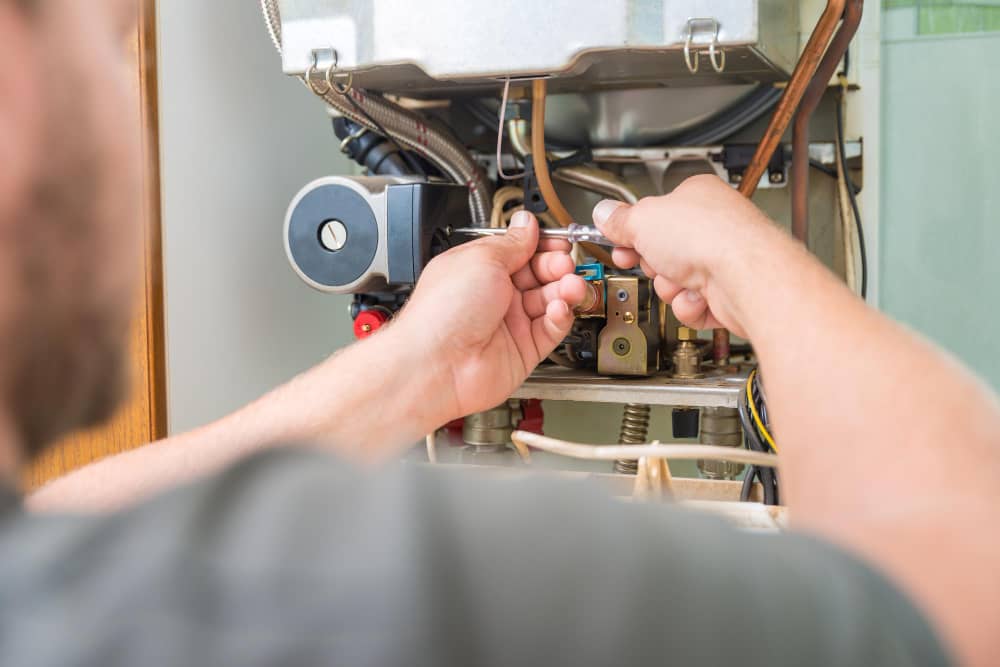
Do not remove the boiler casing or attempt to repair gas components yourself. A suitably qualified Gas Safe registered engineer should carry out gas boiler repair work.
Does the Age of Your Boiler Change the Decision?
Yes, but age alone does not determine whether a repair is worthwhile. A well-maintained older appliance may still be repairable, while a relatively recent boiler could need costly work if a major component has failed.
As a boiler ages, some parts may become harder to source, and the likelihood of further component failures can increase. This can make repeated repairs less attractive, particularly when the appliance has already developed several problems.
When assessing an older boiler, consider:
Its repair history: Has it needed attention repeatedly over the past year or two, or is this the first significant fault?
Parts availability: Can the required component be sourced, and is the repair practical?
The cost of the work: How does the quotation compare with the likely cost of a replacement installation?
Its overall condition: Are there other signs of deterioration, corrosion, leaks or unreliable performance?
Its suitability: Does the existing boiler provide enough heating and hot water for the household?
There is no universal age at which a boiler must be replaced. A professional assessment can help establish whether further repairs are sensible or whether replacement deserves serious consideration.
How Do Repair Costs Compare With Replacement Costs?
The cost of a repair varies according to the fault, the parts required, labour and the time needed to diagnose the problem. A straightforward component replacement may be relatively inexpensive, while a major internal failure can be much more costly.
Replacement involves a different set of costs, including the new appliance, installation labour, materials and any alterations needed to connect it to the heating system.
Rather than comparing one repair quotation with the price of the boiler alone, compare it with the full cost of replacing the appliance.
For example, imagine a homeowner with a boiler that has developed a faulty component after several years of reliable use. If the repair is reasonably priced and no other concerns are identified, repairing it may be the practical choice.
Now consider a boiler that has broken down several times in a short period and needs another expensive component. Even if the latest repair is possible, the homeowner may prefer to compare the cost of replacement and consider the risk of future breakdowns.
These are illustrative situations rather than fixed rules. The right choice depends on the actual fault, the appliance’s condition and the homeowner’s budget.
When Is Replacing the Boiler the Better Option?
Replacement may be more practical when the appliance has developed repeated faults, the repair cost is high or the boiler can no longer be repaired reliably.
It is worth discussing replacement if:
- Major components have failed and the repair is expensive.
- Breakdowns are becoming frequent.
- Suitable replacement parts are no longer readily available.
- The boiler has significant corrosion or other signs of deterioration.
- The appliance no longer meets the household’s heating and hot water needs.
- A professional identifies a safety issue that makes continued use inappropriate.
A replacement can also provide an opportunity to reassess the whole heating system. The installer can check whether the boiler output is suitable, whether existing radiators provide sufficient heat and whether the controls need updating.
However, a new boiler is not automatically more economical in every situation. The potential benefits should be considered alongside the installation cost, expected usage and condition of the existing appliance.
If the current boiler can be repaired safely and reliably at a reasonable cost, keeping it may remain a sensible option.
What Should You Do If Your Boiler Breaks Down Unexpectedly?
If the boiler stops working, begin with simple checks that do not involve opening the appliance or interfering with gas components.
You can:
- Check whether the heating controls and thermostat are switched on.
- Look at the boiler display for an error code.
- Check whether the electricity supply to the appliance is available.
- Consult the manufacturer’s instructions for any permitted user-level checks.
- Note when the problem started and whether the heating, hot water or both are affected.
Avoid repeatedly resetting the boiler if it continues to shut down. Do not remove the casing, dismantle components or attempt to work on gas connections.
If you smell gas, do not operate electrical switches or use naked flames. Leave the property and contact the National Gas Emergency Service on 0800 111 999 from a safe location in Great Britain. Follow its instructions.
If there is a suspected carbon monoxide leak, leave the property and seek emergency assistance. Do not use the appliance again until it has been checked and declared safe.
For non-emergency faults, a qualified engineer can investigate the cause and explain the available repair options.
How Can You Reduce the Risk of Repeat Breakdowns?
No maintenance routine can prevent every fault, but regular professional servicing can help identify developing problems before they lead to a breakdown.
Useful steps include:
- Arrange servicing in line with the manufacturer’s recommendations.
- Keep the boiler and surrounding area accessible.
- Respond promptly to leaks, unusual noises or repeated pressure loss.
- Make sure heating controls are working correctly.
- Ask an engineer to investigate recurring faults rather than repeatedly resetting the appliance.
- Keep service records and paperwork for future reference.
A heating system should also be assessed as a whole. Persistent circulation problems or repeated component failures may involve the wider system rather than a single isolated part.
Make an Informed Decision About Your Boiler
A faulty combi boiler does not always need replacing. The best course of action depends on the cause of the fault, the appliance’s age and condition, the cost of the repair and the likelihood of further problems.
A clear diagnosis gives you the information needed to compare your options without committing to unnecessary work. Where a repair remains practical, it may help extend the useful life of your existing appliance. Where faults are frequent or repairs are no longer worthwhile, a replacement assessment can help you plan the next step.
Ford Plumbing & Heating can help homeowners understand their heating problems and the options available for restoring reliable operation.
With a proper assessment and clear information about the work involved, you can make a confident decision based on your home’s needs rather than assumptions about the boiler’s age alone.
Related articles

Let’s get started, Which fuel powers your boiler?
At a glance
A faulty boiler does not always mean you need a new one. Some problems come from relatively straightforward component failures, while others point to wider wear, recurring faults or an appliance that is approaching the end of its useful life. Knowing the difference can help you decide what to do next without spending money unnecessarily.
For homeowners considering boiler repair Bath services, the most useful starting point is to establish what has gone wrong, how serious the fault is and whether the appliance can be restored reliably.
The age of the boiler matters, but it is not the only factor. Repair costs, the availability of replacement parts, the condition of the wider heating system and the likelihood of further breakdowns should all influence your decision.
This guide explains the signs to look out for, when a repair may be sensible and when it is worth discussing a replacement with a qualified heating professional.
What Are the Signs That a Combi Boiler Needs Attention?
Boiler problems can develop gradually or appear without warning. Some faults affect comfort, while others may indicate that the appliance needs urgent professional attention.
Common warning signs include:
- Radiators staying cold when the heating is switched on.
- Hot water becoming inconsistent or taking longer to arrive.
- The boiler repeatedly switching off or displaying a fault code.
- Unusual banging, humming or kettling noises.
- Water leaking from the boiler or nearby pipework.
- Repeated pressure loss that requires frequent topping up.
- Heating controls failing to communicate properly with the appliance.
These symptoms do not all point to the same cause. For example, cold radiators may be linked to trapped air, a circulation problem or a faulty component. A pressure drop could indicate a leak, an expansion vessel problem or another issue that needs investigation.
It is better to have the cause identified than to assume that the boiler itself has failed.
If the boiler is showing signs of a fault,
When Is Repairing a Combi Boiler Usually Worthwhile?
Repairing a boiler is often worth considering when the fault is clearly identified, the necessary parts are available and the cost is reasonable in relation to the appliance’s condition.
A relatively modern boiler that has been maintained properly may still have many useful years ahead of it. Replacing a faulty sensor, valve or other serviceable component could restore normal operation without the expense of installing a new appliance.
A repair may be a sensible option when:
- The boiler has generally operated reliably.
- The fault is limited to a replaceable component.
- Suitable parts are available.
- The repair cost is proportionate to the boiler’s age and condition.
- There are no significant safety concerns or signs of widespread deterioration.
- The appliance continues to meet the household’s heating and hot water needs.
However, a seemingly small fault can sometimes reveal a more serious underlying problem. A professional diagnosis is therefore important before deciding whether to repair or replace the appliance.
The decision should be based on the likely outcome of the work, not simply the cheapest immediate option.
Which Boiler Faults Can Often Be Repaired?
Many combi boiler problems can be addressed without replacing the entire appliance. The repair required depends on the symptoms, the boiler model and the condition of its components.
| Symptom | Possible cause | Appropriate next step |
|---|---|---|
| No heating | Thermostat fault, circulation issue or boiler component failure | Check the controls and arrange professional diagnosis. |
| Hot water fluctuates | Sensor, heat exchanger or flow-related problem | Have the hot water function assessed. |
| Boiler loses pressure | Leak, expansion vessel fault or pressure-related issue | Arrange checks to identify the cause of the pressure loss. |
| Repeated shutdowns | Faulty sensor, circulation problem or another internal fault | Record any fault code and contact an engineer. |
| Banging or kettling | Restricted circulation, limescale or overheating | Arrange an inspection rather than ignoring the noise. |
| Water leaking nearby | Loose connection, seal failure or internal component problem | Have the source identified and assessed promptly. |
This table is a guide, not a diagnosis. The same symptom can have several causes, and some faults require specialist testing.
Do not remove the boiler casing or attempt to repair gas components yourself. A suitably qualified Gas Safe registered engineer should carry out gas boiler repair work.
Does the Age of Your Boiler Change the Decision?
Yes, but age alone does not determine whether a repair is worthwhile. A well-maintained older appliance may still be repairable, while a relatively recent boiler could need costly work if a major component has failed.
As a boiler ages, some parts may become harder to source, and the likelihood of further component failures can increase. This can make repeated repairs less attractive, particularly when the appliance has already developed several problems.
When assessing an older boiler, consider:
Its repair history: Has it needed attention repeatedly over the past year or two, or is this the first significant fault?
Parts availability: Can the required component be sourced, and is the repair practical?
The cost of the work: How does the quotation compare with the likely cost of a replacement installation?
Its overall condition: Are there other signs of deterioration, corrosion, leaks or unreliable performance?
Its suitability: Does the existing boiler provide enough heating and hot water for the household?
There is no universal age at which a boiler must be replaced. A professional assessment can help establish whether further repairs are sensible or whether replacement deserves serious consideration.
How Do Repair Costs Compare With Replacement Costs?
The cost of a repair varies according to the fault, the parts required, labour and the time needed to diagnose the problem. A straightforward component replacement may be relatively inexpensive, while a major internal failure can be much more costly.
Replacement involves a different set of costs, including the new appliance, installation labour, materials and any alterations needed to connect it to the heating system.
Rather than comparing one repair quotation with the price of the boiler alone, compare it with the full cost of replacing the appliance.
For example, imagine a homeowner with a boiler that has developed a faulty component after several years of reliable use. If the repair is reasonably priced and no other concerns are identified, repairing it may be the practical choice.
Now consider a boiler that has broken down several times in a short period and needs another expensive component. Even if the latest repair is possible, the homeowner may prefer to compare the cost of replacement and consider the risk of future breakdowns.
These are illustrative situations rather than fixed rules. The right choice depends on the actual fault, the appliance’s condition and the homeowner’s budget.
When Is Replacing the Boiler the Better Option?
Replacement may be more practical when the appliance has developed repeated faults, the repair cost is high or the boiler can no longer be repaired reliably.
It is worth discussing replacement if:
- Major components have failed and the repair is expensive.
- Breakdowns are becoming frequent.
- Suitable replacement parts are no longer readily available.
- The boiler has significant corrosion or other signs of deterioration.
- The appliance no longer meets the household’s heating and hot water needs.
- A professional identifies a safety issue that makes continued use inappropriate.
A replacement can also provide an opportunity to reassess the whole heating system. The installer can check whether the boiler output is suitable, whether existing radiators provide sufficient heat and whether the controls need updating.
However, a new boiler is not automatically more economical in every situation. The potential benefits should be considered alongside the installation cost, expected usage and condition of the existing appliance.
If the current boiler can be repaired safely and reliably at a reasonable cost, keeping it may remain a sensible option.
What Should You Do If Your Boiler Breaks Down Unexpectedly?
If the boiler stops working, begin with simple checks that do not involve opening the appliance or interfering with gas components.
You can:
- Check whether the heating controls and thermostat are switched on.
- Look at the boiler display for an error code.
- Check whether the electricity supply to the appliance is available.
- Consult the manufacturer’s instructions for any permitted user-level checks.
- Note when the problem started and whether the heating, hot water or both are affected.
Avoid repeatedly resetting the boiler if it continues to shut down. Do not remove the casing, dismantle components or attempt to work on gas connections.
If you smell gas, do not operate electrical switches or use naked flames. Leave the property and contact the National Gas Emergency Service on 0800 111 999 from a safe location in Great Britain. Follow its instructions.
If there is a suspected carbon monoxide leak, leave the property and seek emergency assistance. Do not use the appliance again until it has been checked and declared safe.
For non-emergency faults, a qualified engineer can investigate the cause and explain the available repair options.
How Can You Reduce the Risk of Repeat Breakdowns?
No maintenance routine can prevent every fault, but regular professional servicing can help identify developing problems before they lead to a breakdown.
Useful steps include:
- Arrange servicing in line with the manufacturer’s recommendations.
- Keep the boiler and surrounding area accessible.
- Respond promptly to leaks, unusual noises or repeated pressure loss.
- Make sure heating controls are working correctly.
- Ask an engineer to investigate recurring faults rather than repeatedly resetting the appliance.
- Keep service records and paperwork for future reference.
A heating system should also be assessed as a whole. Persistent circulation problems or repeated component failures may involve the wider system rather than a single isolated part.
Make an Informed Decision About Your Boiler
A faulty combi boiler does not always need replacing. The best course of action depends on the cause of the fault, the appliance’s age and condition, the cost of the repair and the likelihood of further problems.
A clear diagnosis gives you the information needed to compare your options without committing to unnecessary work. Where a repair remains practical, it may help extend the useful life of your existing appliance. Where faults are frequent or repairs are no longer worthwhile, a replacement assessment can help you plan the next step.
Ford Plumbing & Heating can help homeowners understand their heating problems and the options available for restoring reliable operation.
With a proper assessment and clear information about the work involved, you can make a confident decision based on your home’s needs rather than assumptions about the boiler’s age alone.